

Inside the old Kraus flooring factory in Waterloo, a team led by a couple of ex-tech executives is developing a new factory model to help solve Canada’s housing crisis.
Spread out throughout the 78,000-square-foot facility, workers at Cabinovo are nearing completion on a new modular complex slated for Kitchener, the first step in an ambitious plan to provide zone-compliant missing-middle housing in cities across the country.
The ultimate goal: to build one million homes in 10 years.
The modular rental complexes are built unit-by-unit inside the facility before they are dropped on the back of a truck, driven to their desired lot, and then stacked on site — an empty lot in the morning will be a near-finished housing development by the end of the day with the help of a crane.

A rendering of a finished townhouse by Cabinovo, with two three-bedroom units and two one-bedroom units.
Cabinovo
Kitchener is ground zero, with the first project expected to be completed in January. It’s a proof of concept, with conversations with more than 30 other municipalities already underway.
It’s an ambitious plan, but in a country desperately in need of new housing solutions, the timing couldn’t be better.
In June, the Canada Mortgage and Housing Corporation estimated the country will need to build at least 4.8 million new homes to restore housing affordability to a 2019 benchmark.
All levels of government are working on ways to incentivize builders and reduce red tape, but it means doubling the output based on the current pace of construction.
Cabinovo executive chair Marc Morin knows what it means to scale up quickly.
During the initial dot-com craze, he co-founded and eventually sold the company PixStream to Cisco in a deal for $550 million. He then moved on to Sandvine — acquired by a group of San Francisco partners for $582 million — and most recently served as CEO of Auvik Networks, raising $312 million from the private equity firm Great Hill in 2021, before he stepped down from the role in late 2022.
Before attending the University of Waterloo in the 1980s, Morin grew up in North Bay, the son of a developer who would buy up old homes and turn them into apartment units.
“You know those guys who would buy terrible homes and put in terrible apartments? That was my dad,” he said. “So, I was always interested in rental apartments, but I didn’t like that approach.”
About 14 years ago, he bought an old motel in North Bay, demolished it, and planned to build a 60-unit rental apartment building — “I like to say I bought Schitt’s Creek.”
He put a team together but quickly realized the business plan didn’t work and the costs greatly outweighed any potential revenues.
That always stuck with him. When he left Auvik, that housing bug came back.
“He really just couldn’t help himself,” said Tim Martin, Cabinovo’s chief financial officer. “He was retired, but decided he needed to start another business.”
Martin held senior finance roles at BlackBerry in its golden age before joining Morin at Auvik for nine years.
After leaving Auvik, Morin sold him on his new idea.
“Instead of going after one project and trying to jam it through the system, I thought: let’s try and take the same approach I’ve used with all my other businesses and applying it to housing,” said Morin.
“That’s how it started, but I know nothing. So, then it was about bringing in the right team to really bring this to life”
A mutual connection led him to Derek Henderson, who now serves as president for Cabinovo. He has more than 30 years of construction and manufacturing experience, with a resume that includes vice-president of Z Modular when it had operations in Kitchener.
Tyler Ulmer rounds out the leadership team, and oversees the development of the company’s vertical network — all the homes will be owned and operated by Cabinovo-managed funds, with some also sold to third-party developers and affordable housing providers down the line.
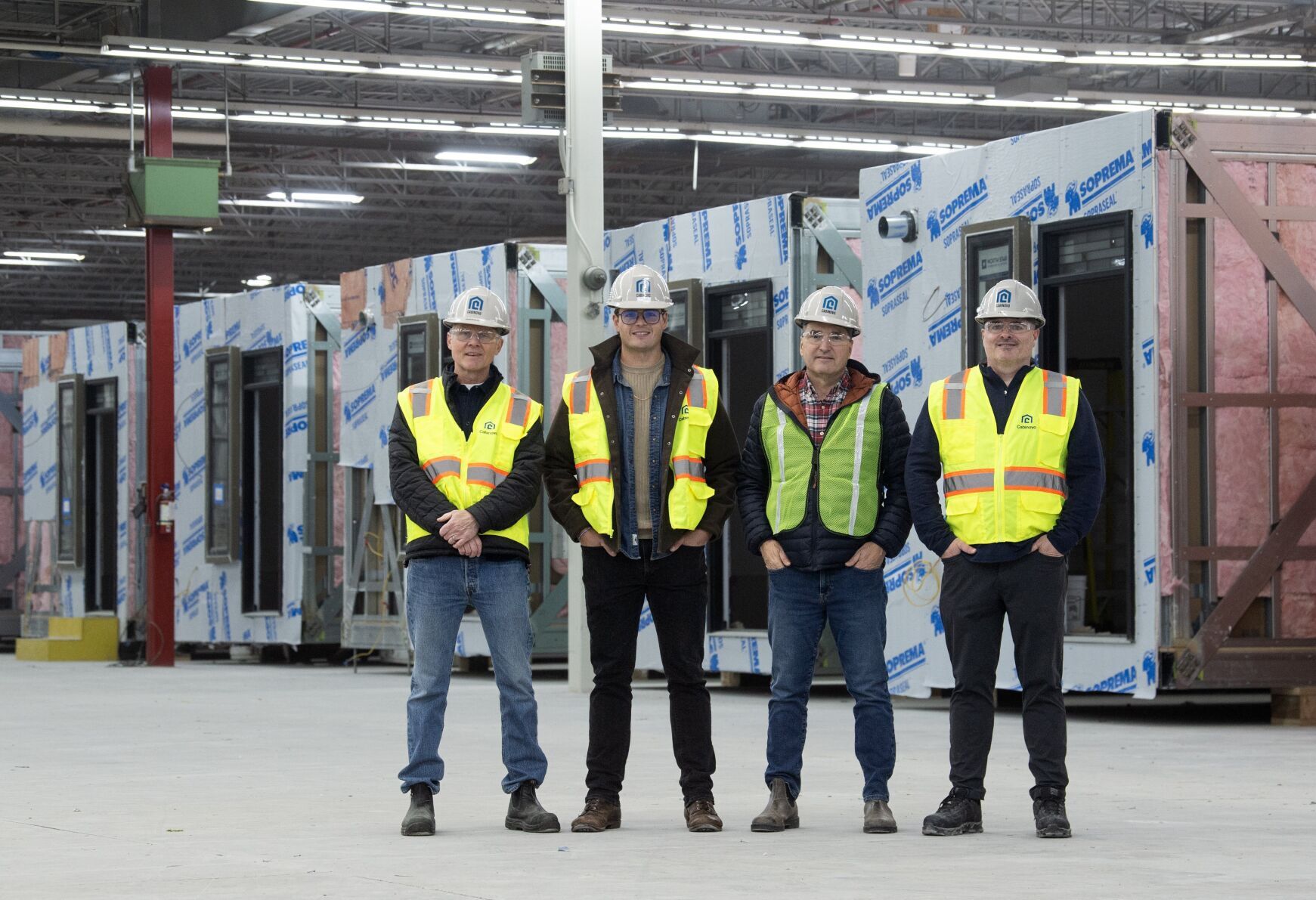
President Derek Henderson, from left, Tyler Ulmer, vice-president, Marc Morin, executive chair, and Tim Martin, chief financial officer, stand in front of housing modules at Cabinovo.
Mathew McCarthy/Waterloo Region Record
After acquiring the Waterloo factory last year, Cabinovo has designed and started building a townhouse model and a multiplex — the townhouse includes two three-bedroom units and two one-bedroom units, and the multiplex offers four three-bedroom units.
There will be opportunities to create different models, but the goal now is to hammer down the details, and figure out the best procedures that can be replicated at scale.
Walking through the factory floors today takes a little visualization to understand what it will become, with humans doing the work that will eventually be automated, in similar vein to an auto plant — picture the Toyota assembly line, but houses instead of cars.
The eventual goal is to create six different building zones, each focusing on separate sections of construction to create a finished product.
They’ve teamed up with Triweco — a Swedish industrial machinery and manufacturing company — to help design the warehouse and supply both the machinery and the software so that each unit is identical in its build process.
Sweden is the gold standard in modular construction, with companies like Lindbäcks able to produce its prefabricated homes in just 30 minutes.
Unlike Lindbäcks, which uses wood frames, Cabinovo will be using steel frames to build its units.
The frames require no welding, are bolted together, and come with a 100-year lifetime, said Henderson.
And due to their building-block construction on site, they can also be moved and reassembled as needed as communities change and grow.
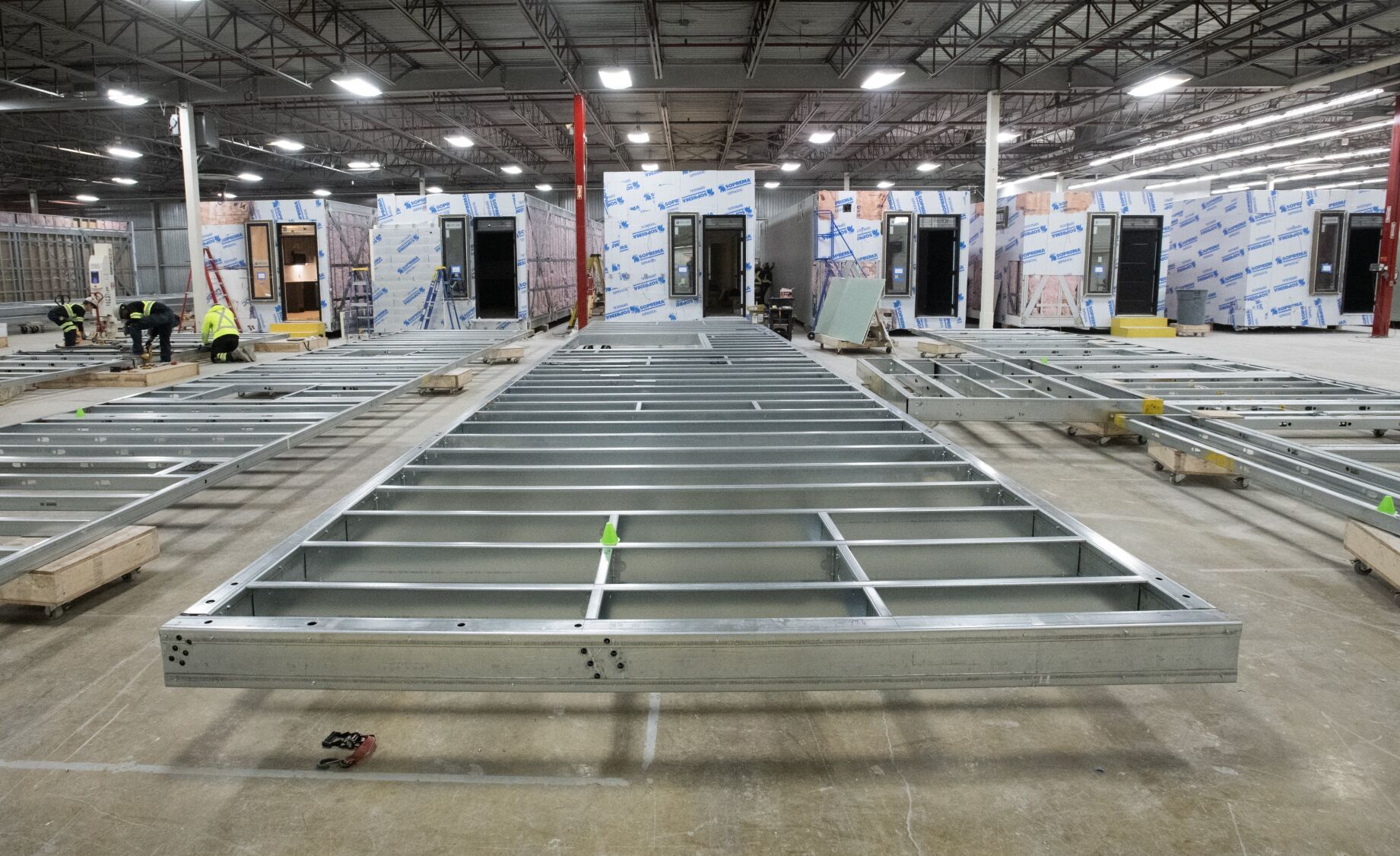
A row of housing modules at Cabinovo.
Mathew McCarthy/Waterloo Region Record
The goal in the factory is to simplify the process so that it opens the work to more people than just traditional skilled construction workers. This is an important consideration for Henderson, who is watching many in his profession head into retirement without enough newcomers in the pipeline.
It’s a growing concern across the country, with a 2023 Buildforce Canada report estimating more than 245,000 construction workers will retire by 2032, creating a shortfall of just over 61,000 workers.
Canada leads the G7 as the most educated workforce because of its large share of college and university graduates, but Statistics Canada reports the number of working-age apprenticeship certificate holders, aged 25-64, has either stagnated or fallen in many of the relevant fields, including construction, mechanic and repair technologies.
That means the more you can simplify the process, the less you need specific skilled trades workers, said Henderson. It grows the potential workforce to choose from, and it offers higher paying jobs to a bigger pool of workers, he said.
“I would like to get to the point where we are so precise that no one will be allowed to carry a tape measurer because they won’t need it,” said Henderson. “Think of it almost like an Ikea build site, where it’s so simple that all you need is one tool to build everything. That’s the type of ease we’re aiming for.”
Inside the units — the one-bedroom is 550 square feet, and the three-bedroom is 1,100 square feet — you’d be hard pressed to spot many differences from a traditional tower unit, with nine-foot ceilings and a full bathroom with a tub.
There is one main outlier: a full kitchen.

Workers install cabinets in housing modules at Cabinovo.
Mathew McCarthy/Waterloo Region Record
“One of the realities is that the most common way to lose money as a rental provider is occupancy turnover,” said Ulmer.
“So, we wanted to create something that people won’t want to leave. With a lot of apartments or condos, maybe you start a family, and you outgrow the space. With a full kitchen and a larger space in general, we’re trying to create something you can actually live in for a long time.”
The goal with the factory formula is to make it easier for city officials to approve each new build, knowing the specs are always the same, and the units meet their codes.
The eventual plan is to build a network of large-scale factories, working round-the-clock to pump out more units.
It’s still early days, and the focus now is to find the right designs and processes so that it becomes like clockwork when it’s time to scale up.
“You do a building a week in Kitchener-Waterloo for a couple of years, and people will notice,” said Morin.
“This phase is all about showing that this works and raising money for the next factory. This isn’t just a Canadian problem, it’s a North American problem, so there is a huge need, and we want to get it right in this phase before we move on.”

