
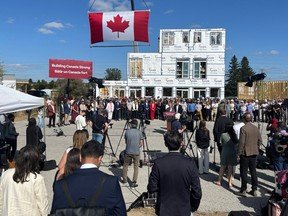
PM Mark Carney’s Housing Photo Op Was Staged, Privy Council Office Confirms
Overview of Recent Housing Announcement Under Scrutiny: A ‘Potemkin Village’ Controversy
In a controversial turn of events, Prime Minister Mark Carney’s September 14 announcement of the new federal housing agency, Build Canada Homes (BCH), has been criticized for staging what many are calling a "Potemkin village." Newly released documents reveal that the housing units showcased during the press event were, in fact, merely temporary structures erected for public display, lacking any foundational infrastructure typical of genuine construction sites.
The terms of the announcement highlighted an initiative aimed at addressing Canada’s pressing housing crisis, with Carney touting rapid home assembly as a potential solution. However, scrutiny following the event revealed that the site—located on a vacant lot in Nepean—was stripped of essential utilities and infrastructure, undermining the legitimacy of the presentation.
In response to inquiries from Conservative MP Arnold Viersen, the Privy Council Office conceded that the displays were a "demonstration" created by Ottawa-based modular home builder Caivan Homes. The notification clarified that the structures were deconstructed shortly after the event and were earmarked for relocation to various housing projects, including a family dwelling in Nunavut. This admission raises concerns about transparency, as neither Carney nor Housing Minister Gregor Robertson mentioned the nature of the demonstration during the event.
The fiscal implications of this staging are significant. Taxpayers were billed over $32,000 for what appears to be a mere public relations exercise. Critics, including Franco Terrazzano from the Canadian Taxpayers Federation, have branded the event as a costly photo op, suggesting that government resources were misallocated in pursuit of a visual narrative rather than substantive policy change.
Despite the intentions behind showcasing rapid construction capabilities, the backlash underscores a broader problem of public trust in government initiatives aimed at addressing housing shortages. The construction industry often relies on credibility and integrity; thus, the perception of insincerity can undermine future collaborative efforts between the public sector and construction stakeholders.
As industry professionals evaluate the implications of this staged announcement, it serves as a reminder of the importance of transparency in showcasing housing solutions. Authentic demonstrations that reflect real-world challenges in housing development may foster trust among stakeholders, reinforcing the critical role that constructive partnerships play in addressing Canada’s housing crisis.
📋 Article Summary
- Prime Minister Mark Carney’s announcement of a new federal housing agency was staged at a site resembling a construction zone, described by critics as a "Potemkin village" for publicity.
- Newly released documents confirmed the site was merely a temporary setup featuring unfinished prop houses, costing taxpayers over $32,000.
- The Privy Council Office admitted the setup was meant as a showcase by a modular home builder, rather than a genuine housing development.
- Critics argue the event misled the public about the government’s efforts in addressing the housing crisis, labeling it a costly photo op.
🏗️ Impact for Construction Professionals
The recent announcement about Prime Minister Mark Carney’s housing initiative, despite being criticized as a "Potemkin village," presents both challenges and opportunities for construction professionals.
Practical Implications: Professionals should analyze the intent behind this announcement—it signals government interest in addressing the housing crisis, which could lead to more federal contracts and funding for housing projects.
Opportunities: There is potential for derived projects in areas such as modular housing or rapid construction techniques, similar to what was displayed. Companies can explore partnerships with government bodies or seek roles in future housing initiatives that may arise.
Challenges: However, skepticism regarding the authenticity of government-led projects may lead to increased scrutiny and stricter regulations. It’s crucial to prepare for rigorous documentation and justification of budgets and timelines.
Actionable Insights: Professionals should refine their proposals to emphasize cost-effective and rapid build capabilities, ensuring alignment with government objectives. Updating operational strategies to be adaptable to potential new policies can enhance responsiveness in a rapidly changing market.
In short, stay informed, be proactive in forming alliances, and adjust business models to align with emerging governmental priorities. This can help elevate your firm’s competitive edge in a transitioning housing landscape.
#Mark #Carneys #housing #photo #faked #Privy #Council #Office #admits

