
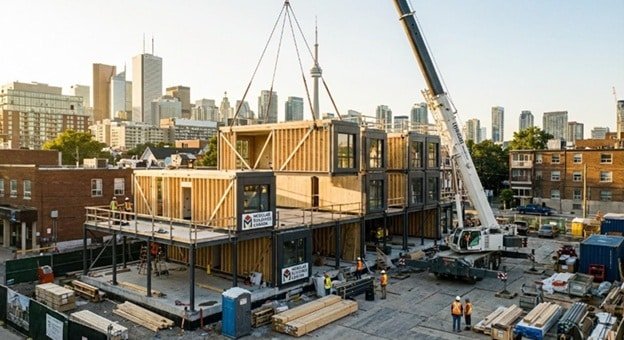
“Addressing Canada’s Housing Crisis: The Need for a Manufacturing Revolution in Modular and Prefabricated Construction”
In light of Canada’s escalating housing crisis, Ladan Hosseinzadeh Sadeghi, President and CEO of Sky Property Group Inc., advocates for the rapid adoption of modular and prefabricated construction techniques. The crisis persists despite substantial government spending and reform efforts across various cities, underscoring the urgent need for innovative solutions in the construction industry.
Modular and prefabricated construction involves manufacturing building components in a controlled factory environment, which are then assembled on-site. This approach presents a compelling alternative to traditional construction methods, especially in Canada, where harsh winter weather significantly hampers outdoor construction projects. By shifting much of the building process indoors, modular construction allows for year-round production, effectively mitigating weather-related delays that can extend timelines and inflate costs.
Recent studies indicate that Canada requires an additional 3.5 million homes by 2030 to restore housing affordability. Conventional methods alone are deemed insufficient to meet this ambitious target within the given timeframe. Modular construction offers a potential solution, with estimated build times that are 30 to 50 percent shorter than traditional methods while maintaining quality standards. This efficiency is particularly critical in urban centers where land and carrying costs are skyrocketing.
Economically, modular construction can notably reduce material waste—by as much as 80 percent—along with enhancing labor efficiency. The consistency and quality control inherent in factory-based processes lead to fewer defects and lower costs associated with post-occupancy remediation. For developers, every month saved on construction translates to reduced interest costs and a quicker return on investment, making modular construction an attractive financial model.
Government authorities are increasingly recognizing the potential of modular construction to address housing shortages. Federal initiatives now prioritize prefabricated housing, with funding directed toward boosting manufacturing capacity. Provinces such as Ontario and British Columbia are witnessing an uptick in modular manufacturing activity, particularly benefiting indigenous communities facing severe housing challenges.
However, barriers remain, notably the shortage of skilled workers familiar with this construction paradigm. To counter this issue, industry stakeholders must invest in evolving trades education to equip workers with the necessary skills for factory-based building methods.
In conclusion, modular construction emerges as a pivotal strategy in addressing Canada’s housing affordability crisis, offering tangible solutions through efficiency, quality, and sustainability. As key stakeholders—developers, financiers, and policymakers—convene to shape the future of Canadian housing, embracing this innovative approach could redefine the landscape, ensuring that housing needs are met swiftly and efficiently.
📋 Article Summary
- Ladan Hosseinzadeh Sadeghi, President & CEO of Sky Property Group Inc., emphasizes the urgent need for accelerated adoption of modular and prefabricated construction to tackle Canada’s housing shortage by 2030.
- Modular construction addresses critical issues like labor shortages and climate-related delays, offering 30-50% faster build times and significant cost savings.
- The Canadian government is increasingly recognizing modular construction as a viable housing solution, with funding and policy support aimed at enhancing manufacturing capacity.
- A significant challenge remains the skill gap in trades familiar with modular methods, necessitating coordinated investment in training and education within the industry.
🏗️ Impact for Construction Professionals
Construction company owners, project managers, and contractors must take note of the increasing emphasis on modular and prefabricated construction in Canada. This represents a transformative opportunity to enhance efficiency and reduce costs. By adopting modular methods, companies could achieve 30-50% faster build times, significantly lowering interest and carrying costs.
To capitalize on this trend, professionals should invest in training and partnerships with modular manufacturers, incorporating these methods into their strategic planning. This proactive step can enhance competitiveness in a tightening housing market where traditional methods lag behind.
However, challenges such as a skilled workforce shortage in modular techniques and supply chain resilience must be addressed. Firms should collaborate with educational institutions to evolve trade curricula and build a workforce adept in factory-based construction.
In their day-to-day operations, embracing modular construction can streamline project timelines, improve quality control, and mitigate risks associated with labor shortages and seasonal weather disruptions. In summary, integrating modular technologies into project plans and workforce development can position companies favorably in a rapidly evolving real estate landscape.
#Canadas #Housing #Crisis #Demands #Manufacturing #Revolution #Case #Modular #Prefabricated #Construction

