
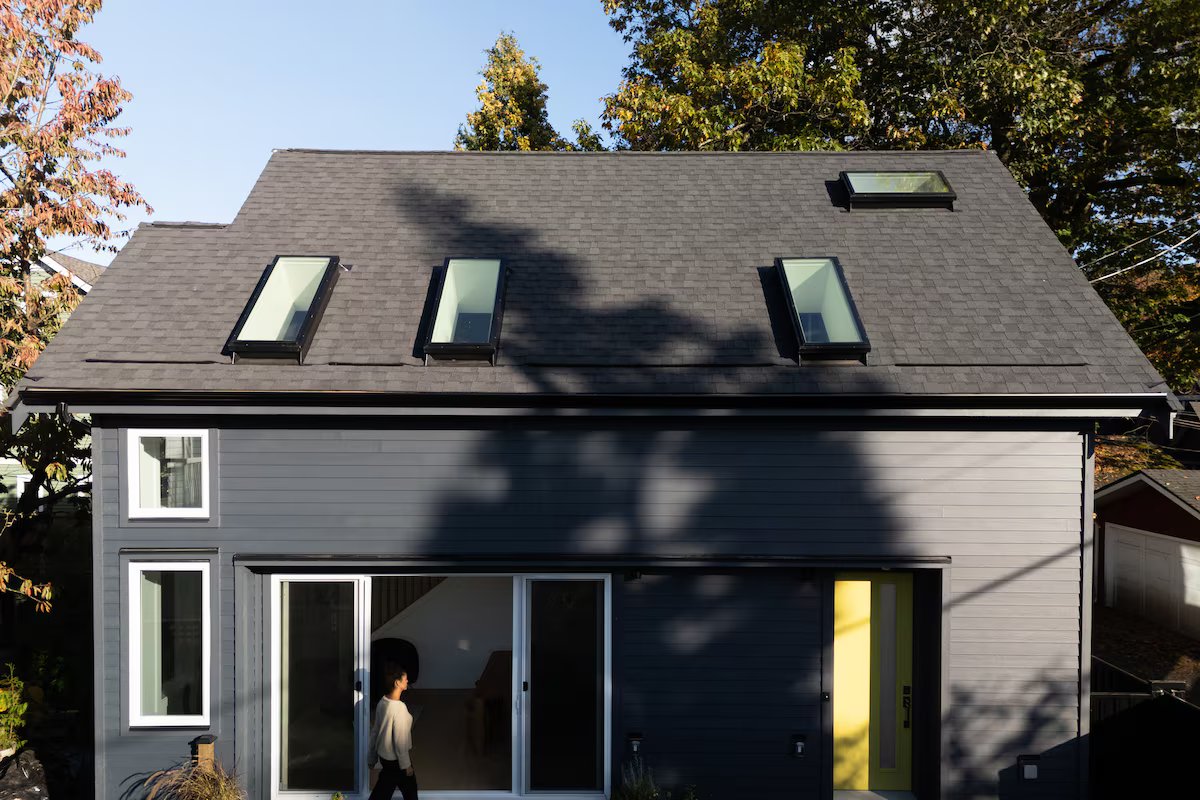
The Vancouver home of Maggie Chao and William Bowden, which uses prefab construction and is designed by Smallworks Ltd.Tyler McLeod/Tyler McLeod
Maggie Chao and William Bowden had been living in London before they returned to Vancouver and began making the move toward home ownership. The millennial-age couple decided to build a house in pricey Vancouver, with the help of Mr. Bowden’s parents, innovative construction and a Canada Mortgage and Housing Corporation (CMHC) grant.
“When we moved back, we kind of pretty immediately started thinking about longer-term housing options. We’ve been renters for all of our adult lives up until that point,” said Ms. Chao.
They looked around and saw what they’d have to spend on a comparable-sized apartment and thought it “was pretty untenable,” said Mr. Bowden. Only the tiniest of units fit their budget, so they ruled out condo living.
Ottawa’s bet on prefabricated homes has promise – and big risks
“I think we saw a few of those and quickly went back to reevaluating the option of laneway houses,” he said.
The couple decided to build a 911-square-foot, two-level, two-bedroom, two-bathroom laneway house on Mr. Bowden’s parents’ 33-foot-wide property in the Commercial Drive neighbourhood, where Mr. Bowden had grown up. The move would give them a house in a desirable neighbourhood with a shared backyard. They chose Vancouver design-builder Smallworks Ltd., pioneers in laneway housing. After signing a contract with Smallworks, the builder asked if they’d like to be a pilot project for a CMHC innovation grant that would require building a highly energy-efficient, mostly prefabricated house. The idea of lower energy bills appealed to the couple.
The couple decided to build the 911-square-foot laneway house on Mr. Bowden’s parents’ 33-foot-wide property.Tyler McLeod/Tyler McLeod
They began the design process in May, 2024, and by February, 2025, they broke ground. By October, they had a turnkey house for $675,669. The CMHC grant, which brought the cost down to around $620,000, came from the CMHC’s Housing Supply Challenge fund, a $300-million pool of money that awards housing practitioners who find ways to boost housing supply.
Smallworks recently made the shift toward prefabricated housing construction, which has long been the standard in other parts of the world but has proven slow to get traction in Canada. The Canadian construction industry typically resists changes to the way homes get built, said co-owner Akua Schatz, largely due to the higher upfront costs of innovative techniques. However, those techniques won’t come down in price until they achieve scale. The Chao-Bowden house, which they call Trifecta House, is their first test case for a hybrid style of construction that they call “mass customization.”
“The construction sector is very slow to adopt new technology,” said Ms. Schatz, who said only 4 per cent of Canadian residential construction uses prefabrication. “Whereas, in let’s say Sweden, for instance, which is one of the leaders in prefab, up to like 80 per cent of their housing is done in prefab.
“They’ve created a much more efficient way of doing housing.”
The bathrooms were fully built and installed into the home as pods.Tyler McLeod/Tyler McLeod
The builder estimates the Chao/Bowden build took four months less than it would have taken to build a traditional stick-built home. To save on an expensive concrete foundation and reduce embodied carbon, the house sits on steel screw piles, a system more often used for construction on boggy ground. The house is built from prefabricated, preinsulated and prerouted panels manufactured in a factory, shipped to the site, and assembled within days. The bathrooms were built off-site as complete, fully plumbed and wired pod units, dropped into the house.
“We’ve been building mostly like a lot of other builders … which is the traditional kind of person in a pickup truck, who brings all the stuff to site, and you build it, stick frame,” said Ms. Schatz.
“But especially with infill housing, you’re going into people’s neighbourhoods, you’re three feet from another neighbour’s property typically … that can be disruptive.”
Millennials whose parents owned a home twice as likely to be homeowners: Statistics Canada
Mr. Bowden and Ms. Chao had the good fortune of being able to build on a property that had long been in Mr. Bowden’s family, a fact not lost on them.
“I would say, yeah, we’re very fortunate there,” said Mr. Bowden. “And a lot of our friends, say the vast majority of our friends, have had varying degrees of financial support from their parents.”
“In some ways, it’s very unfair. Not everybody has that.”
As well, those people who get help from “the bank of mom and dad that will spot them a few hundred K” are also driving prices up, said Mr. Bowden.
Smallworks built the couple a two-level, two-bedroom, two-bathroom laneway house.Tyler McLeod/Tyler McLeod
Most first-time buyers in East Vancouver who want ground-oriented housing will have to fork out $2-million-plus for a house or duplex, or buy into one of the cheaper, new fourplex housing options that are appearing on the market.
Former realtor Bill Laidler helps infill builders purchase properties for multifamily multiplex housing in Metro Vancouver. His Laidler Capital Fund investment portfolio offers financing for the new housing type that is replacing single-family housing. The province required municipalities throughout the province to allow small-scale, multiunit housing in single-family zoned areas by June 30, 2024. Mr. Laidler said the first round of multiplexes in Burnaby just came to market, which he divides into winners, that sold out quickly, and losers, that are still sitting on the market. He said the winners were the homes that were well-designed, that fit within the character of the neighbourhood, and weren’t overbuilt and boxy.
Toronto wrangles with a simple question: What is a multiplex?
He gives the example of a fourplex at 4170 Hurst St. in Burnaby’s Metrotown. There were more than 200 people at the open house, and all four of the large, 2,100-square-foot units sold close to the nearly $1.6-million asking price within 45 days of listing. Interest in fourplexes is driven by millennials and downsizers who want access to the outdoors, he said.
“End-users, homeowners who have another kid and need more space, or who want to downsize and have equity in their homes – those are the most active buyers that we’re seeing,” he said.
Mr. Laidler said he knows from experience what millennial-age buyers want. He and his wife moved from a condo because their family was growing.
“We had to move because my wife didn’t want to think about having a stroller with two kids going up and down elevators and having a concrete patio as the play space,” he said.
“For us, it’s the same: we either move east to find the right size of home, or now that these multiplexes and townhomes are coming into the neighbourhoods … there are more options here for us locally.”

