
Canada to Allocate $1.2 Billion to Boost Forest Sector and Promote Mass Timber Utilization
In a significant move aimed at bolstering Canada’s forest industry, Minister of Energy and Natural Resources Tim Hodgson and Secretary of State for Defence Procurement Stephen Fuhr recently unveiled Budget 2025 investments during their visit to Castlegar, British Columbia. This initiative is pivotal as it seeks to support forest sector workers and businesses during a challenging period of restructuring.
The government has committed up to $700 million over the next two years in loan guarantees enabled through the Business Development Bank of Canada. This financial backing is designed to assist forest companies in maintaining operations and securing necessary financing amidst market volatility. Additionally, an investment of $500 million will be allocated over a three-year period commencing in 2026–27 to enhance Natural Resources Canada’s programs focused on market diversification and the initiation of new export initiatives. This proactive approach aims to stabilize the industry and foster growth in a sector that is crucial to the Canadian economy.
A key component of this strategy is the emphasis on federal procurement policies that will prioritize domestically sourced materials, particularly mass timber and softwood lumber, in construction projects. This mandates that government contractors utilize Canadian lumber, which not only supports local businesses but also aligns with sustainability goals by promoting the use of environmentally friendly construction materials.
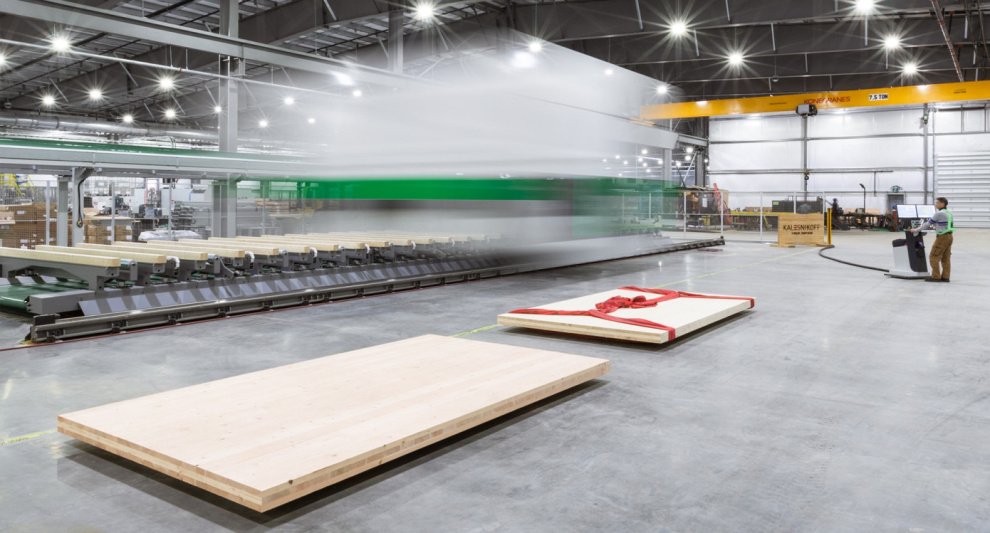
The ministers’ visit to Kalesnikoff’s state-of-the-art mass timber and modular construction facilities further underscores the significance of this initiative. Kalesnikoff produces prefabricated wall and floor systems from British Columbia lumber, which are increasingly utilized in infrastructure projects supported by Natural Resources Canada’s Green Construction Through Wood program. Earlier this year, the federal government facilitated the establishment of a 100,000-square-foot modular mass timber facility with a $3 million investment, showcasing a serious commitment to innovative construction solutions.
These initiatives are instrumental in aligning with the federal Build Canada Homes program, which aims to achieve 500,000 annual housing starts over the next decade. By leveraging mass timber products derived from Canadian wood, the government seeks to enhance domestic consumption and decrease reliance on exports, further strengthening the forest sector’s economic foundation.
In conclusion, Budget 2025 not only reflects Canada’s commitment to revitalizing its forest industry but also lays the groundwork for significant advancements in sustainable construction practices. With planned investments of $1 trillion across various sectors, including housing and infrastructure, these developments will have lasting implications for both the construction industry and the broader economy. As Canada strives to navigate a rapidly evolving landscape, these financial strategies and policy shifts will be crucial in securing the industry’s future.
📋 Article Summary
- The Canadian government is investing up to $700 million in loan guarantees over two years to support the forest industry during restructuring.
- An additional $500 million will be allocated over three years for market diversification and new export initiatives starting in 2026–27.
- Federal procurement will prioritize Canadian materials like mass timber and softwood lumber for construction projects to boost domestic consumption.
- Budget 2025 includes $60 billion in savings to facilitate $1 trillion in investments across housing, infrastructure, and other sectors over five years.
🏗️ Impact for Construction Professionals
The recent announcement of Budget 2025 investments in Canada’s forest industry presents several practical implications for construction company owners, project managers, and contractors. The $700 million loan guarantees will provide financial support for sourcing domestically produced lumber, particularly mass timber, aligned with federal procurement policies. This creates an opportunity to capitalize on local materials, reducing costs and lead times.
To respond effectively, professionals should reassess their supply chains to prioritize Canadian resources, which may enhance competitiveness in bids for government contracts. Engaging with local suppliers like Kalesnikoff could also lead to innovative construction solutions that leverage prefabricated systems.
However, the emphasis on domestic production may pose challenges for those reliant on imported materials. Contractors need to evaluate their procurement strategies to mitigate potential disruptions.
Actionable insights include forming strategic partnerships with local lumber producers and staying abreast of funding opportunities through Natural Resources Canada. Integrating mass timber into projects could not only meet government mandates but also enhance project sustainability—aligning with the broader goal of 500,000 housing starts annually. Overall, this initiative necessitates a proactive approach to supply chain management and project planning.
#Canada #invest #billion #strengthen #forest #sector #expand #mass #timber

