
Fact Check: Allegations of Government Creating Fake Homes for Photo Opportunity Are Misleading
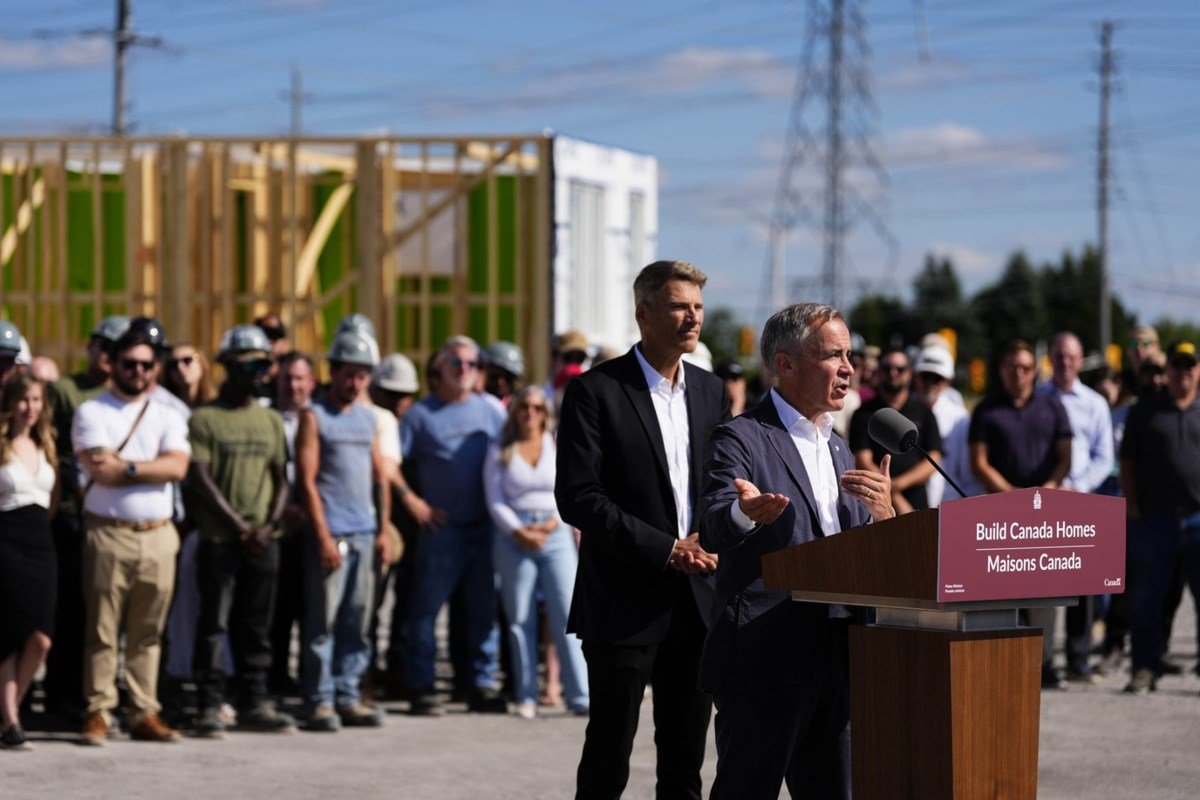
In September 2025, the federal government announced the formation of the Build Canada Homes agency, an initiative aimed at bolstering housing construction in Canada. Prime Minister Mark Carney unveiled plans to develop 4,000 homes across six federally-owned sites, backed by a substantial budget of $13 billion. However, the announcement became mired in controversy as social media users contended that the construction backdrop featured fabricated homes, leading to widespread skepticism regarding the integrity of the project.
Critics claimed that the modular homes showcased during the announcement were incomplete and subsequently dismantled, suggesting a deceptive façade rather than a legitimate production site. A video circulating on platforms like YouTube alleged that Carney had orchestrated a “fake construction site” to mislead the public about the government’s commitment to addressing housing shortages. Such allegations have sparked discussions about transparency and accountability in public sector projects, especially regarding spending taxpayers’ money.
Clarifying these claims, the CEO of Caivan Homes, Frank Cairo, responded by stating that the modular homes were indeed real prototypes, specifically showcased to illustrate the potential of modular construction methodologies. These structures are designed to be manufactured swiftly in a factory setting and then assembled on-site, which highlights an innovative approach to homebuilding that can accelerate projects and lower costs. Cairo emphasized that the exhibition was not intended to signal a permanent housing development but rather a demonstration of manufacturing capabilities.
Moreover, the scrutiny over the $13 billion budget is warranted, as not all funds are allocated solely for the construction of 4,000 homes. The press release also delineated plans for additional programs under the agency, such as a $1.5 billion rental protection fund and a $1 billion commitment to create supportive housing for vulnerable populations, which includes collaborative efforts with various levels of government. This broadened fiscal approach underscores the government’s intent to tackle the multifaceted issue of housing shortages and homelessness through a comprehensive strategy.
Ultimately, the Build Canada Homes initiative represents a significant commitment by the federal government to enhance housing accessibility, albeit amid a backdrop of skepticism. Its focus on modular construction introduces a potentially transformative method within the industry, combining efficiency with cost-effectiveness. As developments unfold, the construction sector will be closely observing how the effective allocation of the $13 billion budget manifests in real-world terms, impacting both housing supply and community well-being.
📋 Article Summary
- The federal government’s Build Canada Homes agency recently announced plans to build 4,000 modular homes, backed by a $13 billion budget.
- Claims surfaced on social media suggesting the construction site was fake and the homes were not intended for permanent installation, which were clarified as prototype builds.
- The entire $13 billion budget is not solely for these homes, as it will also fund various programs including a $1.5 billion rental protection fund and supportive housing initiatives.
- The builder, Caivan Homes, confirmed the homes were real prototypes intended to showcase modular construction’s potential, later to be relocated for actual housing projects.
🏗️ Impact for Construction Professionals
The launch of the Build Canada Homes agency presents both opportunities and challenges for construction professionals. With a $13 billion budget aimed at developing 4,000 homes, this initiative signals increased federal investment in housing, which could lead to a higher demand for modular construction services.
Opportunities:
- Modular home builders can tap into government contracts for the proposed projects. Engage with builders like Caivan Homes, who are already involved.
- Consider diversifying your offerings to include modular solutions, as this method is gaining traction for its speed and efficiency.
Challenges:
- Competition for government contracts may intensify. Stay alert and prepare your bids early by understanding the agency’s goals.
- An influx of contractors may strain resources. Evaluate your workforce and project management strategies to handle potential increased demand effectively.
Actionable Insights:
- Attend industry meetings related to Build Canada Homes to network and learn more about upcoming projects.
- Stay informed about federal funding allocations and explore partnerships or joint ventures to enhance your capacity.
- Adjust your strategic planning to incorporate more modular construction capabilities, which aligns with the government’s objectives for affordable housing solutions.
By proactively responding to these developments, you’ll position your business for growth in a shifting market landscape.
#Fact #File #Claims #government #built #fake #homes #photo #misleading

